01
Background
A friend who works in finance came to me: every contract with a client went through an offline loop — print, sign, photograph, send back. The process was tedious, documents were scattered across chat threads, and reconciliation was entirely manual. I decided to move the whole signing flow online, and to treat it as a complete product exercise: understanding the business, defining the flow, then designing and building it end to end — all on my own.
02
Three constraints
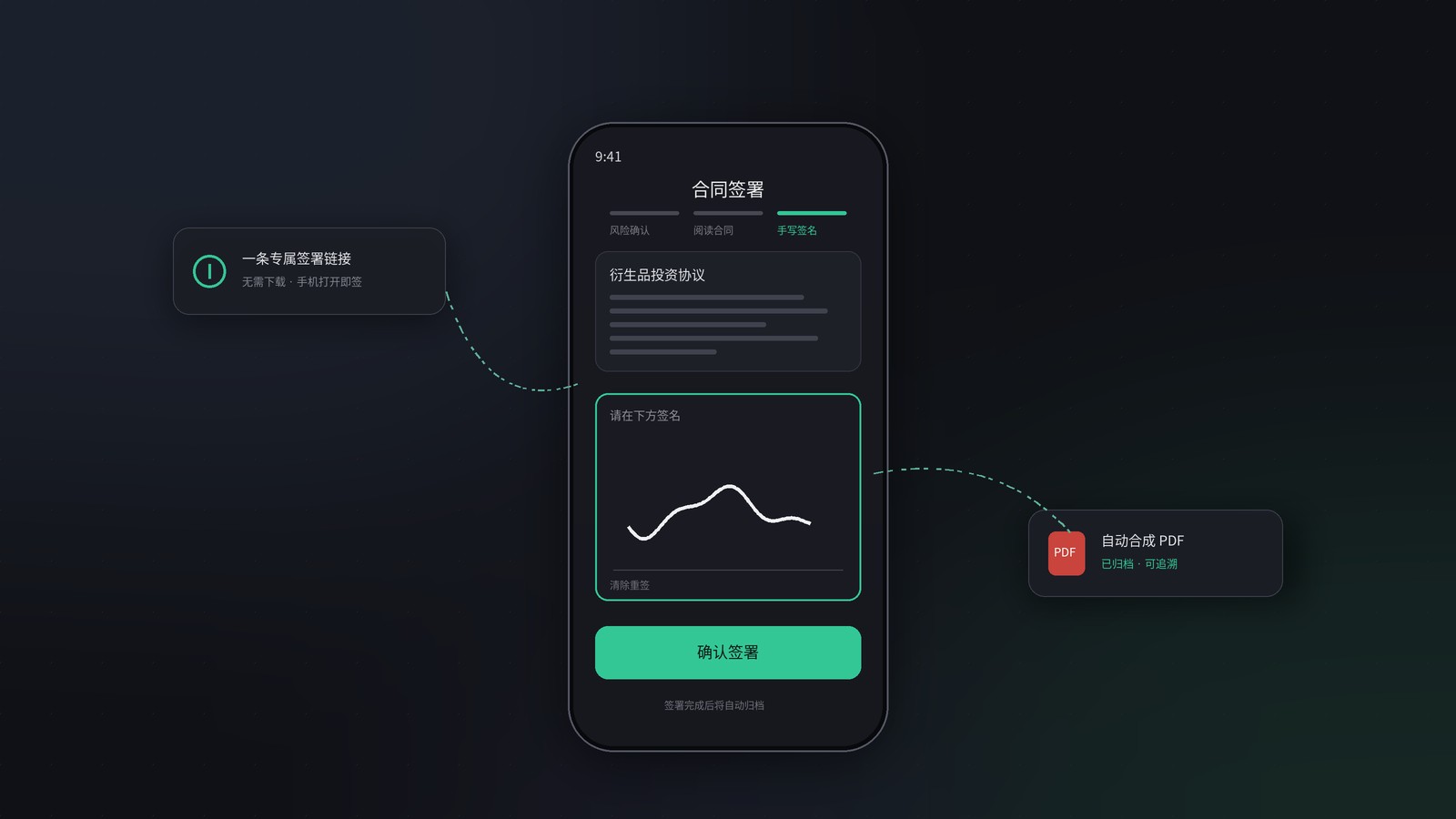
Before starting, three premises set the direction for every design decision: most clients aren't fluent with digital tools, so the flow had to require zero learning; signing happens on a phone, so one link had to carry the entire journey with nothing to download; and these are legally meaningful financial documents, so every step had to be rigorous and traceable.
03
Why so small
I didn't build an app, and I didn't build an admin backend — the final form is as small as it gets: one link, one page, one signature. That wasn't laziness; it was a response to the constraints: for clients unfamiliar with digital tools, every "download, register, learn" is a drop-off point. Knowing what not to build often matters more than building. From request to first usable version took days, not months; every iteration since came from walking the whole flow again and finding what broke. It was my first complete practice of the minimum viable product: get the business running first, then make it better.
04
Two links, each taking its shortest path
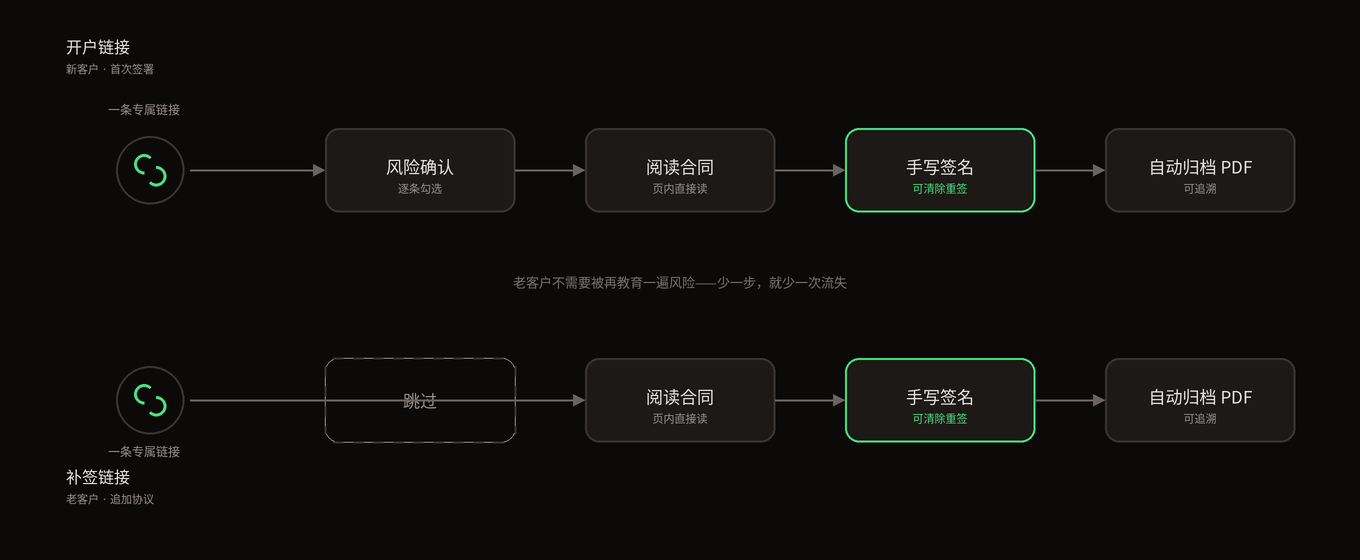
The business really has two signing scenarios: onboarding a new client, and re-signing with an existing one. Instead of one "universal flow," I split them into two independent links — the onboarding link starts with risk confirmation (risk notice → read contract → handwritten signature), while the re-signing link goes straight to the contract (read → sign). A returning client doesn't need the risk lecture again; one step fewer is one drop-off fewer. A few concrete decisions: the risk page lists each notice explicitly and requires a checked confirmation to continue — a compliance act, but not a wall of legal intimidation; the contract is read inline, no redirects, no downloads; the signature pad allows clearing and re-signing, because first handwritten signatures rarely satisfy anyone; and a step indicator sits at the top with the option to go back at any point. Between rigor and smoothness, every step is a balance.
05
The rigor you don't see
The real test of a tool like this is the abnormal path: what if a link is opened twice? What if the connection drops mid-signing? What if two submissions land at once? I handled expired links, duplicate-submission protection, and concurrent writes, and had the system auto-compose the signed PDF and archive it back to the database. In a financial tool, "nothing goes wrong" is itself part of the experience.
06
Outcome
From a friend's one-sentence request to a complete, working system ready to hand over — this project was my first full pass through building for a real business: the requirements were alive, the constraints were real, and mistakes had a cost.