Lab
Ideas & experiments
I'd rather build an idea than keep polishing it on paper. This is where I use AI to test what's in my head — turning concepts into real, working things, fast. Some are still being refined, some just got started, but each one is a genuine attempt to close the gap between thinking and making.
Project
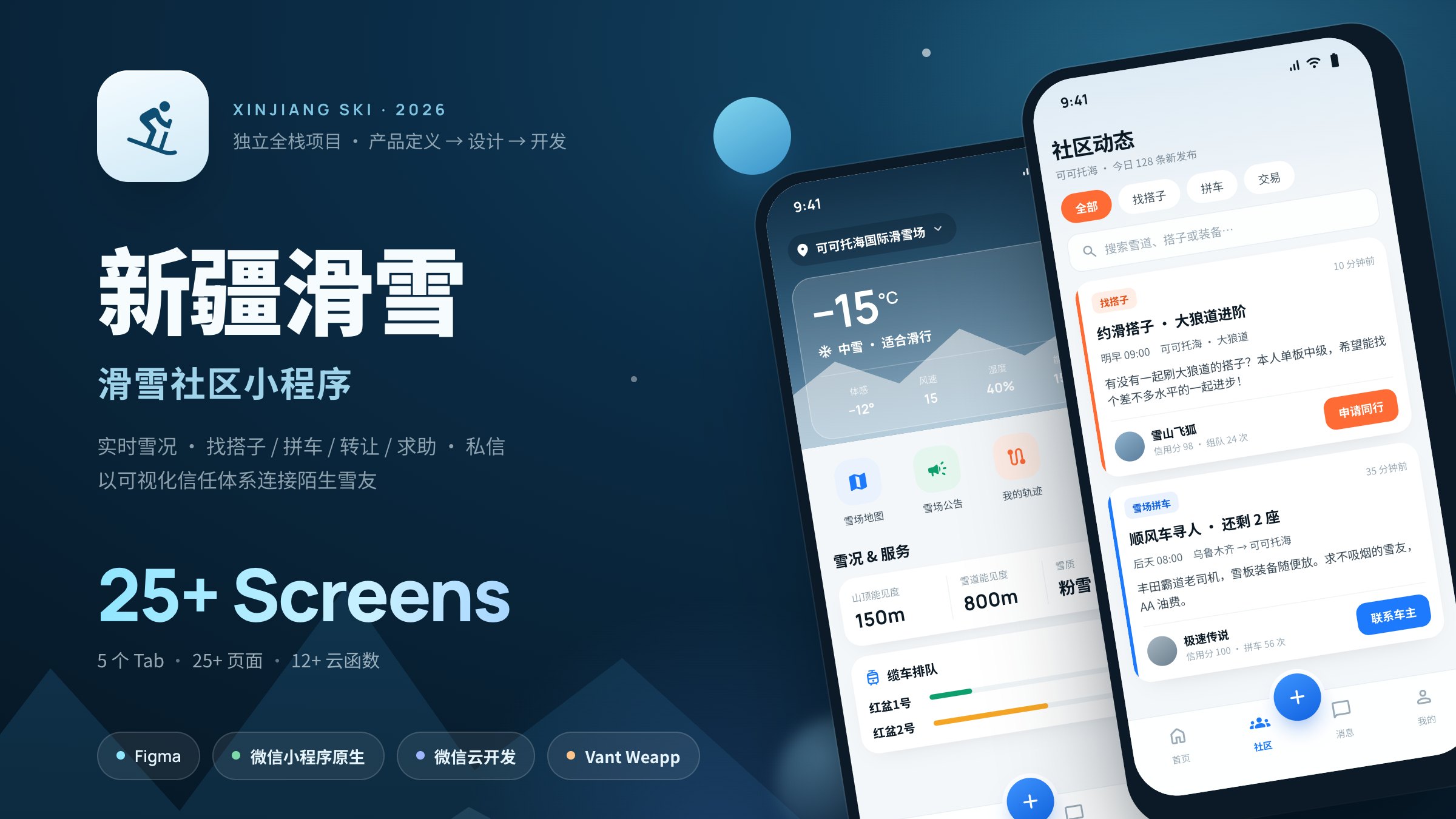
Xinjiang Ski — A Skiing Community Mini-Program
Status
All interface design complete (Figma) · development roughly half done, in progress
Tech stack
Native WeChat Mini-Program · WeChat CloudBase (cloud functions + database) · Vant Weapp · Figma
Description
A complete independent project: from product definition and every screen of interface and interaction design, to the mini-program frontend and cloud-function backend — all built by me alone. Made for skiers at Xinjiang's resorts, it brings together real-time slope conditions, community mutual help (partner matching / carpooling / resale / requests), private messaging, and a trust system as its core differentiator — currently 5 tabs, 25+ pages, and 12+ cloud functions. The whole design is built around a real constraint: skiers operating with gloves on and reading through goggles. Limited attention, restricted operation — interaction design under extreme conditions like these is exactly the kind of problem that interests me most.
Key features
Interaction design for extreme conditions —— 44px minimum tap targets, enlarged hit areas, haptic feedback, a ski-board loading animation — every detail serves the real on-slope context of gloves and goggles.
Trust-system design —— credit score, levels, and badges combined into one visual trust framework, woven through community cards, messaging, and profiles — design that encourages healthy mutual help between strangers.
Real-time conditions system —— color-coded labels (green / yellow / red / orange) communicate lift queues, road status, slope openings, and visibility at a glance, lowering the cost of every decision.
Independent full-stack build —— from Figma designs to mini-program pages, cloud functions, and the database — every layer written by me, including a complete private-messaging system and content-publishing flow.
Project
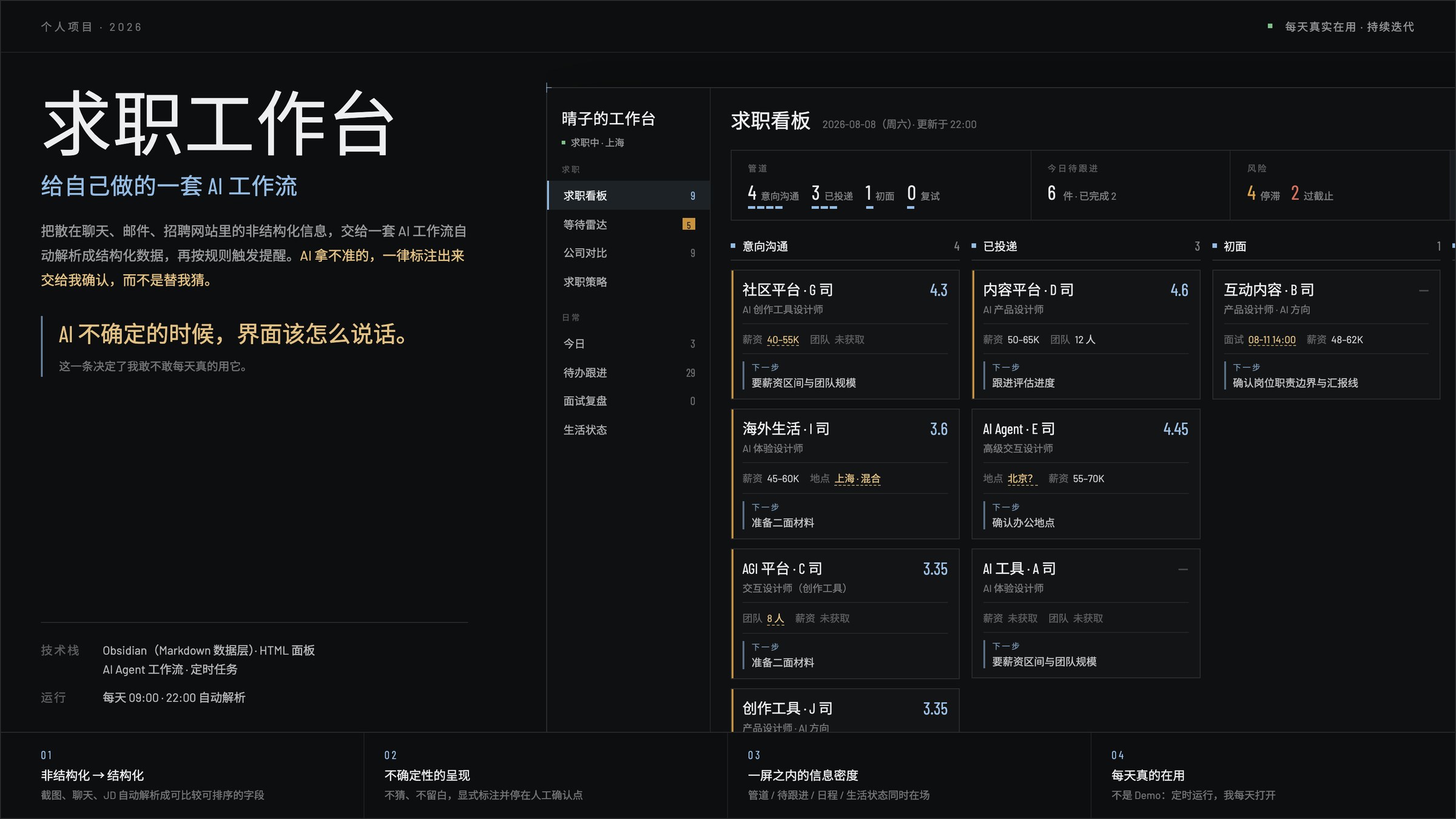
Job-Search Workbench · An AI workflow I built for myself
Status
In daily use · continuously iterated
Tech stack
Obsidian (Markdown data layer) · HTML dashboard · AI agent workflow · scheduled tasks
Description
A job search is a textbook case of too much information, too many scattered states, and a daily obligation to keep up. So I built myself a workbench: unstructured fragments from chats, emails, and job boards get parsed by an AI workflow into structured data, then trigger reminders by rule. What I cared about most in the design wasn't the automation — it was how uncertainty gets shown. Anything the AI isn't sure about is flagged and handed back to me to confirm, never guessed. That single decision is why I actually trust it enough to use it every day.
Key features
Unstructured to structured —— Fragments from screenshots, chat logs, and job posts parsed automatically into fields that can be compared, sorted, and tracked.
Designing for uncertainty —— Fields the AI isn't confident about are neither guessed nor left blank — they're explicitly flagged and held at a human checkpoint. "This isn't trustworthy" is designed into the interface.
Density on one screen —— Pipeline status, follow-ups, schedule, and personal state all live on a single screen. Dense but not crowded — the same problem I spent three and a half years solving on game HUDs.
Actually used, daily —— Not a demo. It runs on a schedule and I open it every morning. Whether I keep using it is the only acceptance criterion I set.
Project
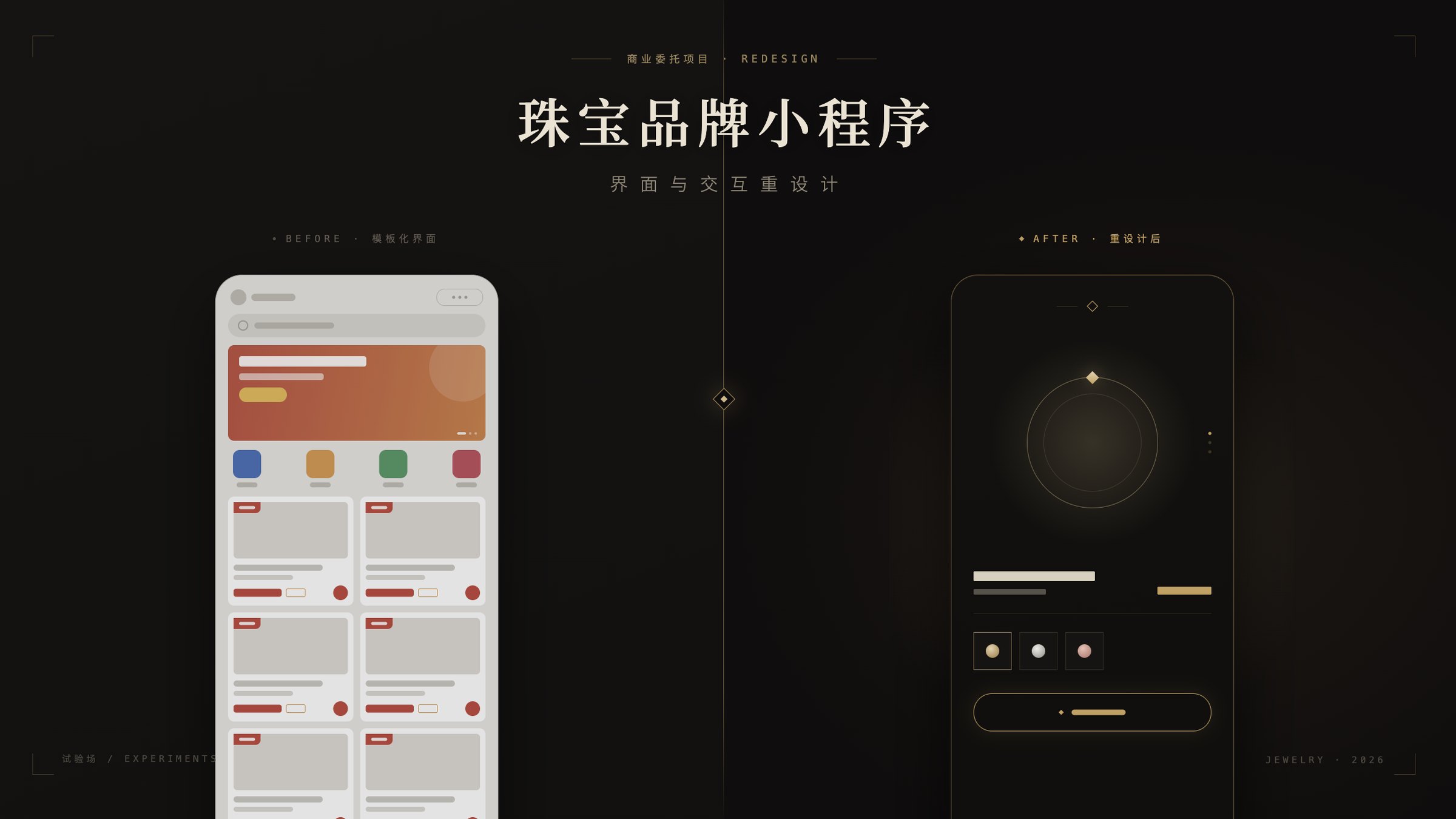
Jewelry Brand Mini-Program · Interface & Interaction Redesign
Status
Commissioned commercial project · In design
Tech stack
WeChat Mini-Program · Figma
Description
A jewelry brand had been running on a templated mini-program — and a generic interface can't carry the sense of quality the category demands. I'm leading a full redesign, reworking the visual language and core flows so that the online store feels worthy of what's in the display case.
Key features
Brand-driven visual language —— color, type, and component details rebuilt around the jewelry brand's identity, moving away from the template look.
Elevated interaction —— core flows and page structures reorganized so browsing and buying feel smoother and clearer.
Business goals in balance —— quality upgrades balanced with guidance and conversion, keeping design in service of the business.